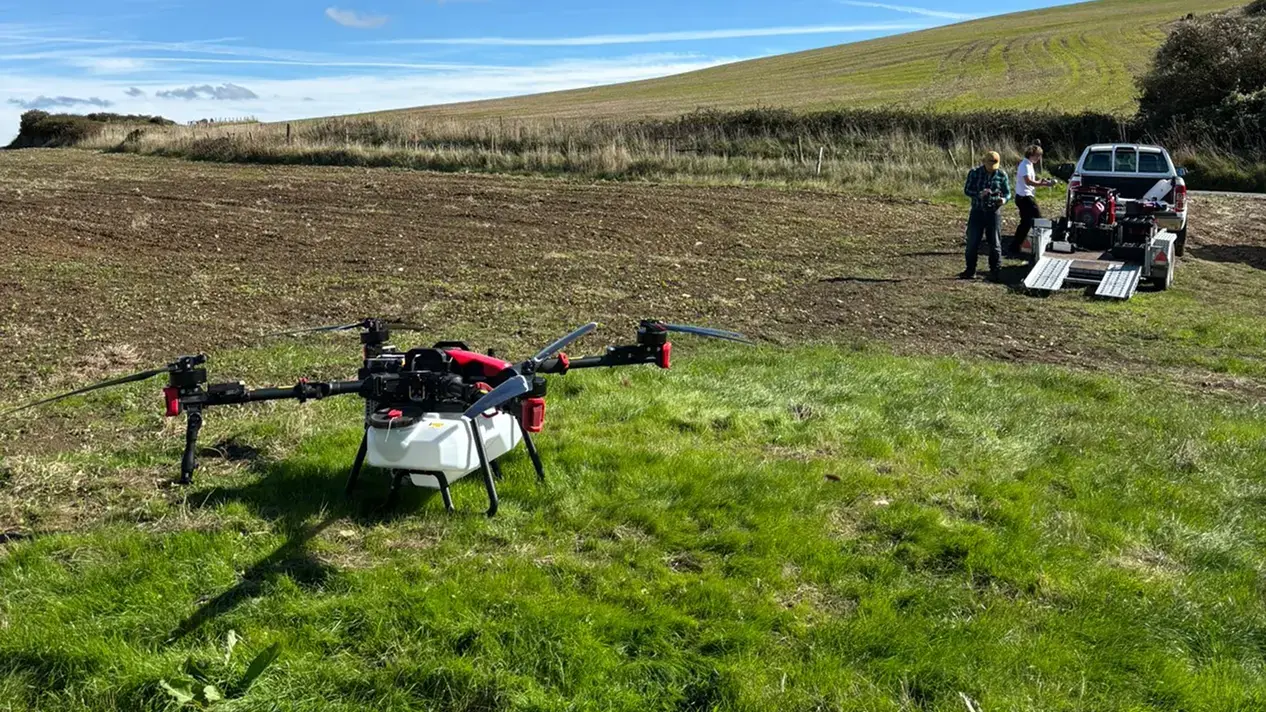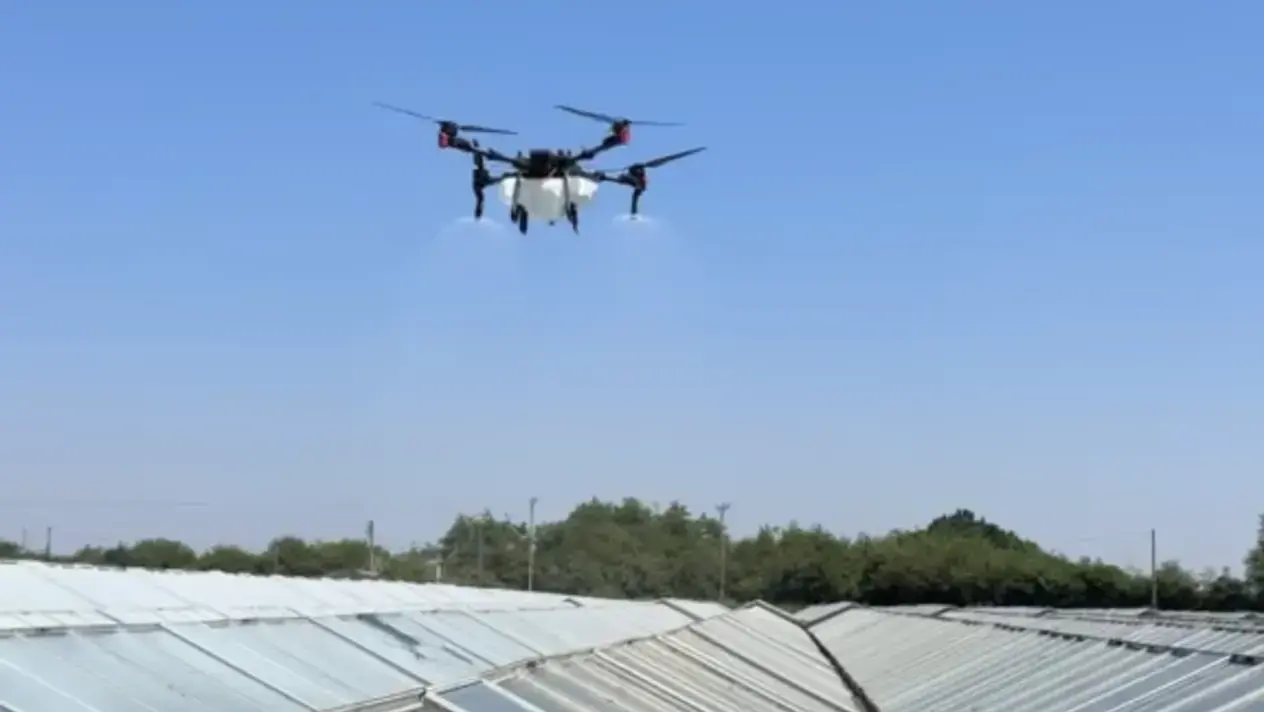
Greenhouse shading should be removed when your crop's light requirement rises above what the coating is still transmitting. As day length and sun angle fall through autumn, a fixed-percentage coating takes a growing share of a shrinking light budget. For southern England growers this crossover usually falls between mid-September and early October, depending on coating strength and crop.
Most growers get to this decision about a fortnight late. Not through carelessness - through waiting until the greenhouse feels dark, by which point the light they were protecting has already gone. Removal depends on rain, and rain doesn't take bookings.
So the real deadline to decide when to remove greenhouse shading sits two to three weeks before you want the roof clear. Which makes the honest answer to "when" a calculation you run in August, not a date you read off a calendar.
Here's how to run it.
What actually decides the date, and why it isn't the calendar
Three inputs, and only one of them is on your wall.
- Your crop's light requirement. Fairly stable through the shoulder season, and you already know it.
- The day length and sun angle curve, which is fixed by latitude and falls faster in September than most people register.
- Your coating's shading factor, which is whatever you mixed it to back in spring - and this is where growers get caught out, because a heavy August top-up is a completely different removal decision from a light early-season layer.
Manufacturers build these products to be mixed to a chosen shading percentage, so two growers three miles apart can genuinely have different correct dates.
The date you want is the crossover: the point where the coating costs you more in lost growth than it saves you in heat control.
Now, the reason growers hesitate is legitimate. Autumn heat spikes still happen, and nobody wants to strip a roof in late September and then cop a fortnight of unseasonable sun. That's a real risk and it's worth saying plainly. But it's a risk you can manage with venting and screens. The light you lose in the meantime doesn't come back.
The light you lose by leaving it on
This is where it gets uncomfortable, so let's use real numbers.
Take Salisbury, at 51.07°N - representative of most Wiltshire and Hampshire glass. On 1 September you get 13 hours 35 minutes of daylight. By 30 September that's down to 11 hours 44 minutes. You lose 1 hour 51 minutes across the month, roughly four minutes a day, every day.
Day length is only half of it. Solar noon elevation over the same month drops from about 47° to about 36°. Lower sun means more reflection off the glass and a longer path through whatever's sitting on it, so the radiation actually reaching your crop falls faster than the clock suggests.
A coating takes a fixed percentage off the top. Think of it like a flat commission on your takings - tolerable in July when the numbers are enormous, painful in late September when they're thin.
Putting a figure on it
Run the second half of September at 51°N and that fortnight carries just under 4% of the year's total solar radiation. Leave a 40% coating on across it and you've given away roughly 1.5% of your annual light budget in fourteen days.
Now convert that to crop. The horticultural rule that 1% light equals 1% production gets repeated constantly, and it turns out to have a proper source behind it: Marcelis and colleagues, published through the International Society for Horticultural Science, put the range at 0.5-1% of harvestable product per 1% of light, with 0.65% for non-flowering pot plants and 0.6-1% for cut flowers.
Here's the part that matters for an autumn decision. That same work notes the effect of light on growth is stronger at lower light levels - which means September and October light converts at the top of the range, not the bottom.
So: roughly 1-1.5% of annual production, lost over a fortnight. For every £100,000 of annual crop value per hectare, that's somewhere around £1,000 to £1,500. Plug in your own turnover and your own shading factor. The arithmetic is the point, not my example.
Why "let the rain take it off" doesn't work
This one costs people real money every year.
Modern coatings are engineered to survive an entire summer of Atlantic weather without degrading. ReduSystems states it outright: the coatings are highly wear-resistant, which means they must be actively removed at end of season. Asking an October drizzle to undo that is asking the product to fail at the one job it was designed for.
What you get instead is patchy clearing. Ridges and exposed runs shed first, sheltered bays and low-pitch sections hold on. You end up with a roof that's neither shaded nor clear, and light distribution across the house that no longer matches how you're growing under it.
Plastic roofs are worse. The manufacturer's own guidance is explicit that certain polycarbonate, acrylic and film covers need rinsing with water after roughly fifteen minutes, because rain removal alone can be insufficient. If your removal plan is "wait for weather," those houses simply don't clear.
And residue doesn't reset over winter. It sits there through the darkest months, compounds with next season's application, and quietly shaves light off a year you haven't started yet. If you want it done properly and on a date you chose, greenhouse shading removal by drone takes the weather guesswork out of the timing.
What removal actually involves, and where it goes wrong
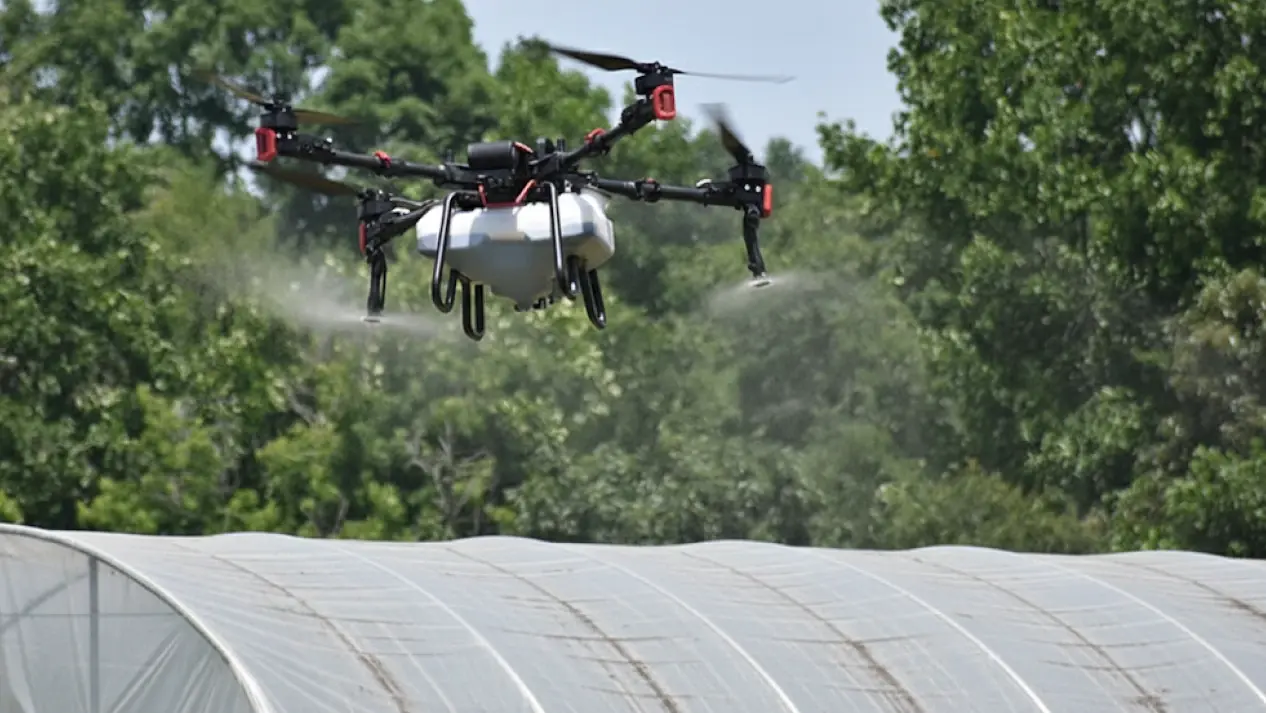
Not a method guide - these are the failure points, because every one of them is a job that gets re-done.
Dosage depends on a dry roof. The specification is 250 litres of remover per hectare at a dilution between 1:5 and 1:7, applied to a dry surface. Apply onto a damp roof and your effective dilution is no longer what you calculated. You get an uneven film and incomplete lift.
Coverage has to be total. The manufacturer's instruction is blunt: sections that aren't moistened will not be removed. Miss a bay and it stays on until spring.
Wrong remover, wrong result. Standard remover handles ReduSol, ReduHeat and ReduFlex Blue. Diffuse coatings - ReduFuse and ReduFuse IR - need a different version entirely, and a tighter rain window with it. If you've run SprayChalk as a summer top-up over a base coat, you need to know what's actually up there before anything goes on.
Wind kills the application. Guidance caps spraying at 2 m/s - about four and a half miles an hour. Combine that with needing a dry roof and rain within a few days, and the genuinely workable windows in a given autumn are narrow.
None of this is difficult. All of it is easy to get wrong at four o'clock on a Friday when someone's rushing to finish.
Getting it off the roof without putting anyone on it
The safety argument here isn't decoration, and the numbers are not ambiguous.
HSE data shows falls through fragile surfaces account for 22% of all fall-from-height fatal injuries in construction - and specifically flags that people doing small, short-duration maintenance and cleaning jobs are over-represented in those statistics. That's this job. Precisely this job.
In agriculture the picture is starker still. HSE's own guidance states that roughly half of all deaths and serious injuries from falls in agriculture involve work on fragile roofs. Greenhouse glazing bars, rooflights and older sheeting all belong in that category.
The Work at Height Regulations 2005 set the hierarchy plainly: avoid work at height where reasonably practicable, before you get anywhere near thinking about harnesses and boards. A ground-operated method isn't a premium option bolted onto the top of a safety plan. It's the first rung of the hierarchy working exactly as intended, and it's the answer the regulations point at before any other.
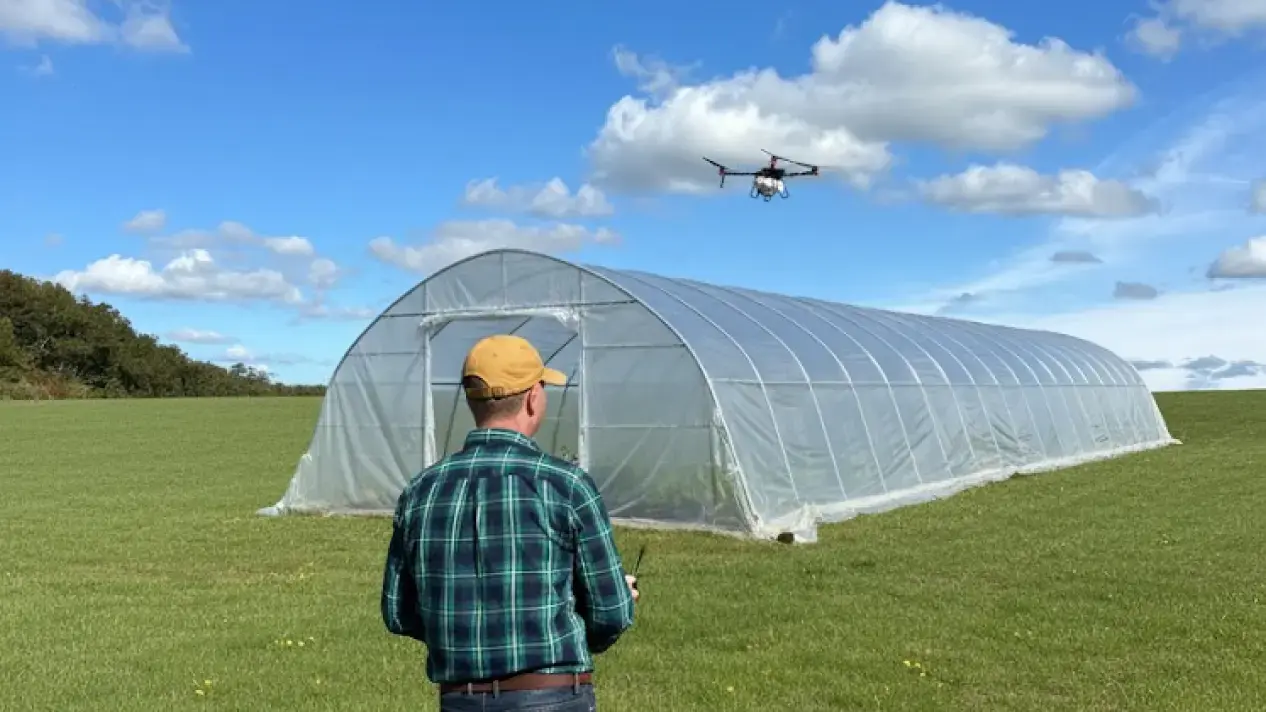
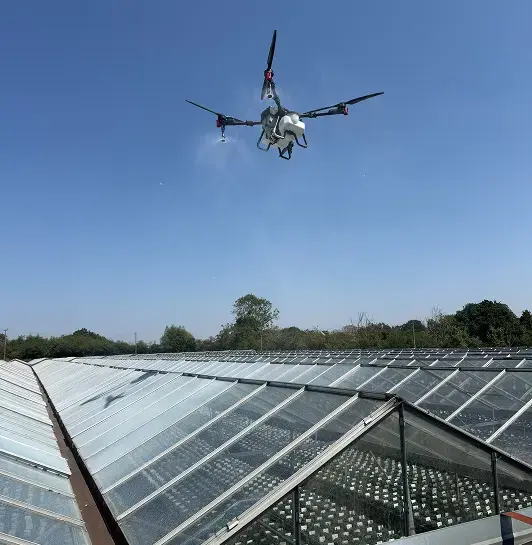
That's also why our greenhouse and polytunnel shading and cleaning work is done from the air rather than off the sheets. On a recent job we cleared 16,000 m² at Yard House Plants inside a single day, with nobody on the roof at any point. Speed matters here for a reason that isn't convenience - it's what lets you complete a whole site inside one workable weather window instead of splitting it across three.
Booking your removal window
Work out your own crossover date first. Take your coating's shading factor, your crop's light requirement, and the day length curve for your postcode. That gives you the week you want the roof clear.
Then subtract two to three weeks. That's when the call needs to happen.
The scarcity here is real rather than manufactured: removal needs a dry roof, low wind, and rain within a few days, and those conditions cluster into a handful of usable days across a few weeks. Every grower in Wiltshire, Dorset and Somerset is waiting on the same weather. Whoever booked in August gets the good windows.
Send four lines - roof area, covering type, coating you ran this year, and the week you want it clear. That's enough for us to come back with a date.
The growers who get caught out aren't the ones who chose the wrong week. They're the ones who never chose at all, and let October decide for them - which reliably costs more than the removal did.
Book a removal day in your window, not the weather's
Tell us what you're running and we'll tell you what's realistic. We work with glasshouse growers in Somerset and across the South West, whatever coating system you already use.
If you'd rather have that decision in your own hands, Drone Spraying UK can clear the whole site while the weather holds. See our end-of-season shading removal service or get in touch.